A light pops up on your dashboard and your stomach drops. Is the car about to die? Can you finish the drive? This guide shows every common dashboard warning light with a picture, says what it means in plain words, and tells you exactly what to do. Start with the colour, because it tells you most of what you need to know.
Dashboard warning light colours: the quick answer
Car dashboard symbols work like traffic lights:
- Red: stop soonA serious problem or a safety issue. Pull over as soon as it’s safe and check what it means.
- Yellow or orange: check soonSomething needs attention, but it usually isn’t an emergency. Drive carefully and get it looked at.
- Green or blue: a system is onNothing is wrong. A feature is switched on, like your headlights, turn signals or cruise control.
A few lights that only mean “this is switched on” are yellow or red too, like the rear fog light and the hazard lights. They’re in the indicator section below. Your owner’s manual has the exact meaning of every light in your own car.
Dashboard symbols chart
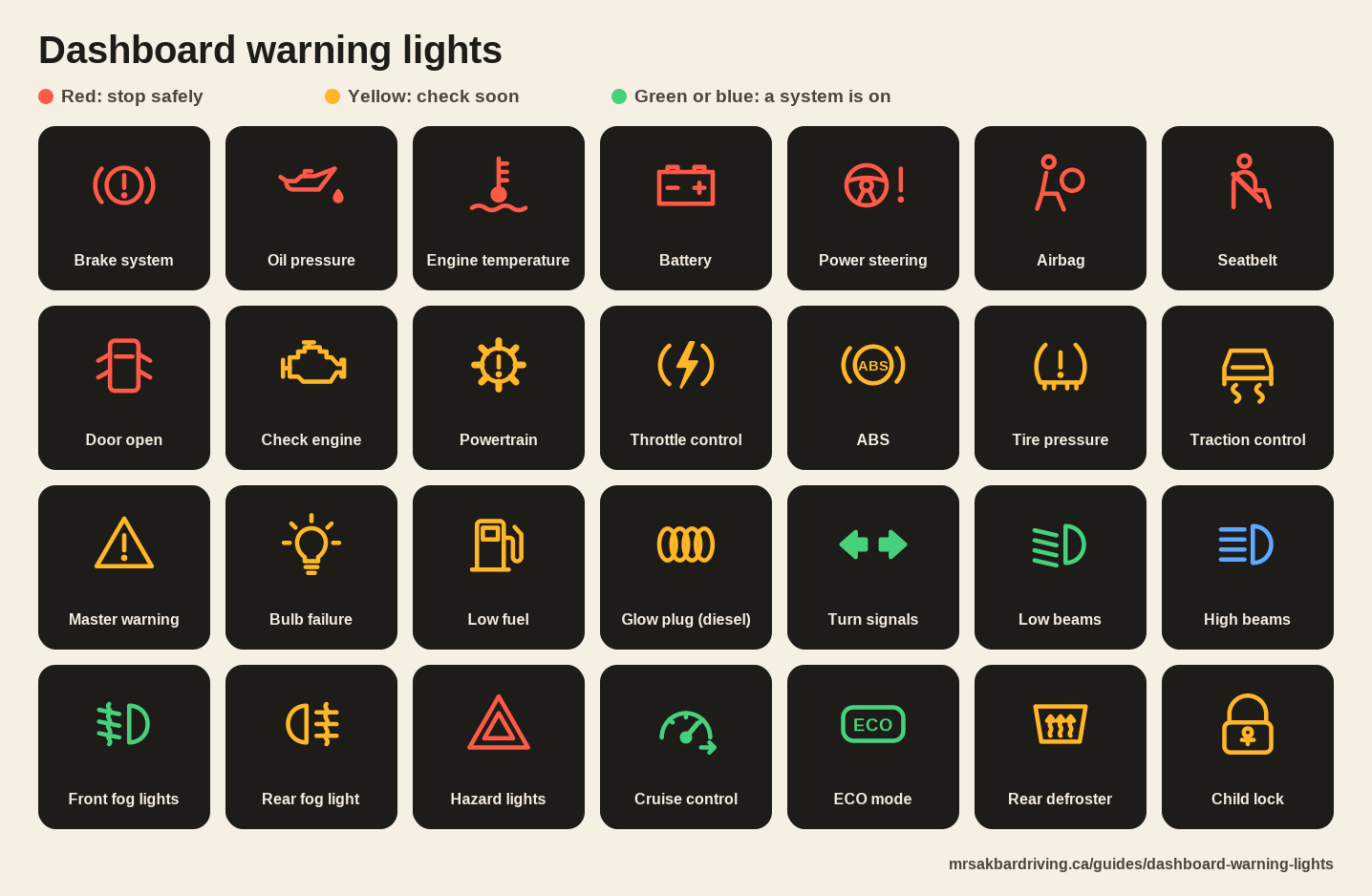
Each symbol is explained below with a bigger picture, grouped by colour.
Why every light comes on when you start the car
Turn the key or press the start button and the dashboard lights up like a birthday cake. That’s normal: the car is testing its bulbs and systems. They should go out within a few seconds.
Ontario’s Driver’s Handbook says to check that your warning lights and gauges work before you drive, and to watch for a light that stays on after you pull away, because it could mean a serious problem.
Tip
A two-second habit
Before you put the car in gear, glance at the dashboard. Anything still lit after start-up is something to deal with before the drive, not halfway down the highway.
Red warning lights: stop as soon as it’s safe
A red light means a problem that can hurt you or the car. Don’t ignore it, and don’t keep driving to “see what happens.”
Brake system warning light
Looks like: An exclamation mark in a circle, with brackets on both sides. Some cars show the word BRAKE.
What it means: The parking brake is on, the brake fluid is low, or the brake system has a fault.
What to do: Make sure the parking brake is fully off. If the light stays on, pull over safely and get help. Don’t drive on brakes that might fail.
Oil pressure warning light
Looks like: An old-fashioned oil can with a drip.
What it means: The engine isn’t getting enough oil pressure. Without it, an engine can be badly damaged quickly.
What to do: Pull over safely and turn the engine off. Once it has cooled, check the oil level with the dipstick, and get help before driving on.
Engine temperature warning light
Looks like: A thermometer floating in waves.
What it means: The engine is overheating. In some cars, a blue version of this light just means the engine is still cold.
What to do: Pull over safely, turn the engine off and let it cool. Never open the radiator cap on a hot engine: the coolant is under pressure and can burn you.
Battery or charging warning light
Looks like: A car battery with plus and minus signs.
What it means: The car isn’t charging its battery, usually because of a problem in the charging system. The car runs on what’s left in the battery, then stops.
What to do: Turn off things you don’t need, like the radio and seat heaters, and drive straight to somewhere safe or a garage. Switching off may mean the car won’t restart.
Power steering warning light
Looks like: A steering wheel with an exclamation mark beside it.
What it means: The power steering has a fault. You can still steer, but the wheel may suddenly feel much heavier, especially at low speed.
What to do: Hold the wheel firmly, slow down and pull over somewhere safe. Get it checked before you drive on.
Airbag warning light
Looks like: A seated person with a big circle in front of them. Some cars show SRS.
What it means: The airbag system has a fault, so the airbags may not work in a crash.
What to do: The car still drives normally, but get it checked as soon as you can. Your seatbelt matters even more until it’s fixed.
Seatbelt reminder light
Looks like: A seated person wearing a seatbelt.
What it means: You or a passenger isn’t buckled up. Many cars chime as well.
What to do: Buckle up. In Ontario, the driver and every passenger must wear a seatbelt.
Door open warning light
Looks like: A car seen from above, with its doors open.
What it means: A door, the trunk or the hood isn’t fully closed.
What to do: Stop somewhere safe and close it properly before you drive on.
Yellow and orange warning lights: get it checked soon
A yellow or orange light means something isn’t right, but you can usually drive carefully to a garage. If a yellow light starts flashing, or the car feels different, treat it like a red one.
Check engine light (engine management light)
Looks like: An outline of an engine. Some cars show the words CHECK ENGINE.
What it means: The engine computer has found a problem. It can be minor, like a loose fuel cap, or more serious.
What to do: If it’s steady, book a check soon. If it’s flashing, many cars are warning of a serious problem: slow down, avoid hard acceleration and get it checked right away.
Powertrain or transmission warning light
Looks like: A gear, like a cog, with an exclamation mark inside.
What it means: In many cars, a fault in the powertrain: the parts that send power to the wheels, usually the transmission. The car may limit its power to protect itself.
What to do: Drive gently to a garage. If the car shifts strangely, slips or loses power, pull over safely and get help.
Electronic throttle control light
Looks like: A lightning bolt between two brackets.
What it means: A fault in the electronic throttle, the system that connects your gas pedal to the engine. The car may switch to a reduced-power mode.
What to do: Drive carefully to a garage, and expect less power when you speed up. Get it checked soon.
ABS warning light
Looks like: The letters ABS in a circle, between brackets.
What it means: The anti-lock braking system has a fault. Your normal brakes still work, but the wheels can lock up if you brake hard.
What to do: Leave extra space, brake early and gently, and get it checked soon. If the red brake light comes on too, stop driving and get help.
Tire pressure warning light (TPMS)
Looks like: A tire seen from the side, like a horseshoe, with an exclamation mark.
What it means: One or more tires is under-inflated. Low tires grip, steer and brake worse, and wear out faster.
What to do: Check all four tires with a gauge and fill them to the pressure on the tire sticker, usually inside the driver’s door frame.
Traction control or stability control light
Looks like: A car with two wavy skid marks under it.
What it means: Flashing while you drive: the system is working, stopping your wheels from spinning on a slippery road. Staying on: the system is switched off or has a fault.
What to do: If it’s flashing, ease off the gas and slow down. If it stays on, check you haven’t switched it off by accident, then get it checked.
Master warning light
Looks like: An exclamation mark in a triangle.
What it means: A general warning: the car has a message for you, usually shown on the screen between your gauges.
What to do: Read the message on the dashboard screen, or look it up in the owner’s manual. Some cars show this light in red for urgent problems.
Bulb failure warning light
Looks like: A light bulb with rays around it.
What it means: A bulb on the outside of the car is out: a headlight, brake light, turn signal or another light.
What to do: Walk around the car with the lights on, and ask someone to watch while you press the brake. Replace the bulb soon; an examiner checks your lights before a road test.
Low fuel warning light
Looks like: A gas pump.
What it means: You’re running low on fuel. Most cars keep a small reserve, but how far it lasts varies.
What to do: Fill up soon. Running out on a busy road or highway is a hazard for you and everyone around you. On many gauges, a small arrow beside the pump shows which side your fuel door is on.
Glow plug light (diesel engines)
Looks like: A coil, like a spring.
What it means: Only in diesel cars. When you turn the key, the glow plugs are warming the engine so it can start, especially in cold weather. The light should go out after a few seconds.
What to do: Wait for it to go out before you start the engine. If it flashes or comes on while you’re driving, many diesels are warning of an engine fault, so get it checked.
New to driving, and the dashboard still looks like a cockpit? Call or text Mrs. Akbar.
Green, blue and other indicator lights: a system is on
These lights don’t mean anything is wrong. They tell you a feature is switched on, so you can check it’s the one you wanted.
Turn signal indicators
Looks like: Two green arrows, pointing left and right.
What it means: Your turn signal or your hazard lights are on.
What to do: Switch it off once your turn is done; a leftover signal confuses other drivers. If it blinks much faster than usual, a bulb is probably out.
Headlight indicator (low beams)
Looks like: A headlight with lines sloping down.
What it means: Your low-beam headlights are on.
What to do: Ontario requires your lights from half an hour before sunset to half an hour after sunrise, and whenever you can’t see clearly 150 metres ahead.
High beam indicator
Looks like: A blue headlight with straight lines.
What it means: Your high beams are on.
What to do: Switch to low beams within 150 metres of an oncoming vehicle, and when you’re within 60 metres behind another one.
Front fog light indicator
Looks like: A headlight with sloping lines crossed by a wavy line.
What it means: Your front fog lights are on.
What to do: Use them in fog together with your low beams, and turn them off once you can see clearly again.
Rear fog light indicator
Looks like: A lamp facing the other way, with straight lines crossed by a wavy line. Usually yellow or orange.
What it means: Your rear fog light is on: a very bright red light at the back of the car.
What to do: Use it only in thick fog, and switch it off as soon as you can see properly, because it can dazzle the driver behind you.
Hazard lights indicator
Looks like: A red triangle inside a triangle.
What it means: Your hazard lights, the four-way flashers, are on: all your turn signals flash together.
What to do: Use them when you’re stopped or broken down where you could be a hazard, like on a highway shoulder. Switch them off once you’re moving normally again.
Cruise control indicator
Looks like: A speedometer with an arrow.
What it means: Cruise control is on or set, and the car is holding your speed.
What to do: Ontario’s Handbook says not to use cruise control in snow or other bad weather. Your foot on the brake switches it off.
ECO mode indicator
Looks like: The letters ECO, often in green.
What it means: The car’s fuel-saving mode is on, or you’re driving in a fuel-efficient way.
What to do: Nothing to do. It’s good news, and smooth, gentle driving keeps it lit.
Rear window defroster indicator
Looks like: A rectangle, the back window, with wavy arrows pointing up.
What it means: The rear window defroster is heating the glass to clear fog, frost or ice.
What to do: Many cars switch it off by themselves after a few minutes. Clear every window properly before you drive, not just a little peephole.
Child lock indicator
Looks like: A padlock, sometimes with a child symbol inside.
What it means: In cars with electric child locks, the rear doors can’t be opened from inside, and often the rear windows are locked too.
What to do: Keep it on with young children in the back, and remember to switch it off when adults ride there.
Steady or flashing: what the difference means
The same light can mean different things depending on whether it’s steady or flashing:
- Check engine light flashing: in many cars, a more serious engine problem than a steady light. Slow down and get it checked right away.
- Traction control light flashing: the system is working on a slippery road. Ease off the gas.
- Tire pressure light flashing at start-up, then staying on: in many cars, the tire monitoring system itself has a fault.
- Turn signal flashing fast: a bulb is probably out on that side.
- Glow plug light flashing while you drive: in many diesels, an engine fault. Get it checked.
A red light just came on: what to do
- Don’t panic, and don’t slam on the brakes. Check your mirrors first.
- Signal and pull over somewhere safe, off the road if you can: a side street, a parking lot or, on a highway, the shoulder.
- Turn on your hazard lights if you’re stopped near traffic.
- Look the light up here or in the owner’s manual.
- Call for help if the light means the car shouldn’t be driven, like oil pressure, overheating or brakes.
On a highway, the Handbook’s advice is to start pulling over at the first sign of trouble rather than waiting for the car to stall, and never to stop in a driving lane. The highway guide has the details.
Warning lights and your road test
Before a road test, the examiner checks that the car is in proper working order: signals, brake lights, horn and more. A car with a problem can get the test declared out of order, and you lose half the fee. So if a warning light is on, or a bulb is out, get it fixed before test day, and do the start-up glance in the parking lot.
The Hamilton DriveTest centre guide lists what the car check looks for.
“Very knowledgeable instructor, she knows what the ministry require you to do and she will teach you that.”
Sources
- Driver’s Handbook: getting ready to drive (ontario.ca) (opens in a new tab)
- Driver’s Handbook: maintaining your vehicle (ontario.ca) (opens in a new tab)
- Driver’s Handbook: dealing with emergencies (ontario.ca) (opens in a new tab)
- Driver’s Handbook: driving at night and in bad weather (ontario.ca) (opens in a new tab)
- Road test vehicle requirements (drivetest.ca) (opens in a new tab)
Quick answers
What do the colours of dashboard warning lights mean?
Red means a serious problem or a safety issue, so stop as soon as it’s safe. Yellow or orange means something needs checking soon. Green and blue mean a system is on and working.
What does the exclamation mark in a circle mean on my dashboard?
It’s the brake system warning light. The parking brake may be on, the brake fluid may be low, or the brakes may have a fault. If it stays on with the parking brake off, pull over and get help.
What does the triangle with an exclamation mark mean?
It’s the master warning light. The car has a message for you, usually shown on the screen between the gauges.
What does the check engine light mean?
The engine computer has found a problem, from something small like a loose fuel cap to something more serious. Steady means book a check soon; flashing, in many cars, means get it checked right away.
Can I drive with the check engine light on?
If it’s steady and the car drives normally, usually for a short time, but book a check soon. If it’s flashing, slow down and get it looked at right away.
What does the oil light mean?
Low oil pressure. Pull over safely and turn off the engine, because driving without oil pressure can quickly damage it.
What does the battery light mean while driving?
The car isn’t charging its battery. It runs on what’s left in the battery and then stops, so head straight somewhere safe or to a garage.
What does the tire pressure light mean?
At least one tire is low. Check all four and fill them to the pressure on the tire sticker, usually inside the driver’s door frame.
What does the car with squiggly lines mean?
It’s traction or stability control. Flashing means it’s helping on a slippery road; staying on means it’s switched off or has a fault.
What does the gear with an exclamation mark mean?
In many cars, a powertrain or transmission fault. Drive gently to a garage, and pull over if the car shifts strangely or loses power.
What does the coil light on my dashboard mean?
It’s the glow plug light in a diesel car. Wait for it to go out before starting the engine. If it flashes while you drive, get the engine checked.
What does the steering wheel warning light mean?
The power steering has a fault. You can still steer, but it may feel much heavier, so slow down and pull over somewhere safe.
What does the blue light on my dashboard mean?
Usually that your high beams are on. In some cars, a blue thermometer means the engine is still cold, which is normal for the first few minutes.
Is it normal for all the warning lights to come on when I start the car?
Yes. The car tests its lights at start-up, and they should go out within a few seconds. One that stays on needs attention.
Why is my turn signal blinking fast?
A bulb is probably out on that side. Check the front and rear signal lights.
put it into practice
Get comfortable in the driver’s seat
Lessons start with the car itself: the controls, the mirrors and what the dashboard is telling you.
5.0 stars from tons of Google reviewsShe comes to you